1

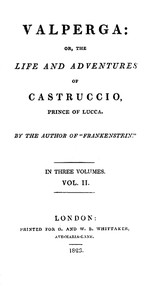
Valperga Volume 2 (of 3) or, The life and adventures of Castruccio, prince of Lucca — Inside the Classic
266
10
Project Gutenberg
2020
Historical fiction; Castracani, Castruccio, 1281-1328 -- Fiction; Guelfs and Ghibellines -- History -- Fiction; Condottieri -- Fiction; Italy -- History -- 1268-1492 -- Fiction; Lucca (Italy) -- History -- Fiction
Readers of public-domain and historical texts
Project Gutenberg digital edition
en
Edition facts
Words: 56,745
Reading time: 247 min
Text sections: 5
Source:
Project Gutenberg record #63338
This editorial note examines Mary Shelley's diction, dialogue, and descriptive choices in Valperga Volume 2, focusing on how she uses festival scenes, political debate, and character interactions to reveal Castruccio's ambition and Euthanasia's moral conflict, without summarizing the plot.
Editorial Edition Score
4.7/5
★★★★★
★★★★★
Calculated from edition completeness, EPUB availability, text structure and catalogue metadata. Not a user rating.
Edition quality
Mary Shelley opens Volume 2 with a festival in Florence, where bells ring and youths parade singing Dante and Guido. The celebration, however, is for a lioness giving birth to five whelps—an omen the Florentines take as a sign of divine favor. Castruccio laughs at this, but a grave citizen rebukes him, linking the lions' welfare to the city's fate. Shelley uses this exchange to establish a world where political meaning is read into natural events, and where Castruccio's skepticism sets him apart from the superstitious populace. The dialogue is crisp: Castruccio's question is met with Euthanasia's ironic suggestion to ask a man whose face shows no merriment, revealing her own detachment.
Diction and the Language of Power
Shelley's diction in political conversations is precise and revealing. When Castruccio exiles three hundred families, he tells Arrigo Guinigi, "This city is not big enough for them and me." The casual, almost flippant tone contrasts with the gravity of the act. Later, Euthanasia reflects that princes learn "a cunning in cruelty the prosperous can never know." The word "cunning" suggests a calculated, learned behavior rather than innate malice. Shelley avoids melodrama; instead, she lets the characters' word choices expose their worldviews. Castruccio speaks of "security" and "vigorous measures," while Euthanasia uses "tyrants" and "beggars." The narrator's own voice intrudes with a philosophical aside on rulers losing "the idea of his own individuality" and sacrificing real people to the "fiction" of the state. This shift from dialogue to authorial commentary underscores the moral stakes without didacticism.
Dialogue as a Mirror of Conflict
The exchanges between Euthanasia and Arrigo Guinigi reveal the emotional and ideological rift caused by Castruccio's actions. Euthanasia's questions are urgent and fragmented: "what had caused this change, and whether he knew what the schemes of Castruccio were?" Arrigo's replies are evasive, first claiming ignorance, then defending Castruccio as "noble-minded, but firm of resolution." Shelley uses repetition—Euthanasia's repeated "what does he mean?"—to convey her desperation. The dialogue also shows how characters talk past each other: Euthanasia speaks of human suffering; Arrigo speaks of state necessity. When Castruccio later visits Valperga, he adopts "the frankness of manner for which he was remarkable," a phrase that hints at performance. Shelley's dialogue thus serves not just to advance plot but to dramatize incompatible moral frameworks.
Description and the Weight of Setting
Shelley's descriptive passages are economical but loaded. The festival scene is painted with sensory details: "bells were ringing; the country people were flocking into the town; and the youths of both sexes, of the highest rank, and richly dressed, were parading the streets, covered with wreaths of flowers." The image of singing to "the accompaniment of many instruments" evokes a harmonious public life that contrasts with the political discord beneath. Later, the castle of Valperga is described only as a place where visitors gather, but the emotional weight is carried by Euthanasia's internal state: "it unveiled at once the idol that had dwelt in the shrine of her heart." Shelley uses metaphor sparingly but effectively—the "idol" and "shrine" suggest a religious devotion now shattered. The physical settings (Florence, Valperga) are never mere backdrops; they are stages where public and private dramas intersect.
Recurring Details and Structural Echoes
Shelley employs recurring motifs to bind the volume. The lion omen in Chapter I returns implicitly in later political calculations: Castruccio's actions are justified by appeals to security and fate. The word "firm" appears in Arrigo's description of Castruccio and echoes earlier descriptions of his character. Euthanasia's phrase "cunning in cruelty" resonates with Castruccio's later plotting of assassination. Shelley also repeats the structure of private conference followed by public action: Castruccio meets Galeazzo Visconti and the Bishop of Ferrara in Chapter I, then enacts exile in Chapter VII. These echoes create a sense of inexorable progression. The narrator's philosophical interjection—on rulers losing individuality—is a structural pause that invites readers to reflect on the pattern of tyranny. Such details reward close attention to Shelley's craft.
Readers attentive to Shelley's authorial choices will notice how she balances historical detail with psychological depth. The diction, dialogue, and description work together to create a world where political necessity and personal morality are in constant tension. Rather than offering easy judgments, Shelley presents characters whose words and actions reveal the complexity of power. This volume rewards those who read for the subtle interplay between what is said and what is left unsaid.
Reader reflection
How will you remember this book?
Save your reaction, strongest insight, and memorable passage.
Your progress
0
/
10
2
Was reading this book enjoyable?
3
Would you pass this book on to a friend?
4
How much effort did this book require?
5
Which aspect of the book did you value most?
6
How clearly were the main ideas presented?
7
Would this book work well in a reading group?
8
How well did it match your expectations?
9
In one sentence, what did you learn?
10