1

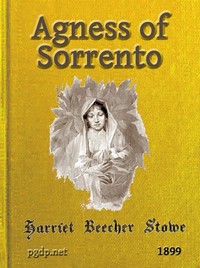
Agnes of Sorrento — Story, Setting & Ideas
531
8
Project Gutenberg
2013
Historical fiction; Savonarola, Girolamo, 1452-1498 -- Fiction; Catholic Church -- Italy -- History -- To 1500 -- Fiction; Papacy -- History -- 1447-1565 -- Fiction; Sorrento (Italy) -- History -- Fiction
Readers of public-domain and historical texts
Project Gutenberg digital edition
en
Edition facts
Words: 122,321
Reading time: 532 min
Text sections: 12
Source:
Project Gutenberg record #43076
Harriet Beecher Stowe's 1862 novel set in 15th-century Italy, where a young woman's piety becomes a lens for examining tensions between personal faith and institutional religion, as seen through the monk Francesco's struggle with earthly love and the looming figure of Savonarola.
Editorial Edition Score
4.8/5
★★★★★
★★★★★
Calculated from edition completeness, EPUB availability, text structure and catalogue metadata. Not a user rating.
Edition quality
Stowe opens her Italian novel not with a grand historical tableau but with the intimate geography of Sorrento: 'The old town of Sorrento lies like a nest of white sea-birds on a cliff that juts into the blue Mediterranean.' This precise, almost painterly description establishes a setting that is both idyllic and precarious. The narrative voice frequently shifts between close observation of domestic life—a dove-cot, a garden, a young woman singing—and broader reflections on the political and religious turmoil of late 15th-century Italy. The excerpts reveal a work deeply concerned with the friction between personal devotion and institutional authority, particularly through the character of Father Francesco, a monk whose spiritual struggles are rendered with psychological detail. Stowe uses the figure of Girolamo Savonarola not merely as a historical backdrop but as a living presence whose reformist zeal casts a shadow over the characters' choices.
The Monk's Divided Heart
The most sustained psychological portrait in the excerpts belongs to Father Francesco, a monk tormented by his attachment to Agnes. Stowe presents his inner conflict through a series of vivid contrasts: he hears Agnes singing a hymn to Jesus, yet the hymn 'was blent with the remembrance of Agnes.' The narrator explicitly states that 'it was only in the heart of a lowly maiden that Christ had been made manifest to the eye of the monk.' This is not a simple love story but a theological dilemma: Francesco's love for Agnes is inseparable from his love of God. Stowe traces this tension through his prayer, where he cries, 'Why, why cannot I find Thee? Oh, take from my heart all other love but Thine alone!' Yet even this plea is 'blent with the remembrance of Agnes.' The excerpts also show a secondary conflict with Father Johannes, who suspects Francesco of lingering 'earthly love.' The monastery becomes a stage for competing interpretations of spiritual purity, with Francesco caught between his own heart and the judgment of his brethren.
Art, Architecture, and the Visible World
Stowe embeds visual art into the narrative as a marker of spiritual decay or possibility. She references Michelangelo's 'fearful painting' in the Sistine Chapel, which she describes as embodying 'that image of stormy vengeance which a religion debased by force and fear had substituted for the tender, good shepherd.' This is a pointed critique of the institutional church's aesthetic—and by extension, its theology. In contrast, the natural beauty of Sorrento and the humble piety of Agnes offer an alternative visual language. The excerpts also mention 'an antique form' of lamp and the 'glimmer of the taper' in Francesco's cell, small details that anchor the story in a tangible, sensory world. Stowe's descriptive style often lingers on light, shadow, and texture, creating a setting that feels both historically specific and symbolically charged. The novel seems to ask whether beauty—in art, in nature, in a human face—can lead the soul toward God or away from Him.
The Weight of History: Savonarola and the Papacy
Though the excerpts focus on personal drama, the catalog subjects and chapter titles indicate a broader historical canvas. Chapters such as 'Florence and her Prophet,' 'The Attack on San Marco,' and 'The Cathedral' suggest that Savonarola's reform movement and the political machinations of the papacy form a crucial backdrop. Stowe, writing in 1862, was herself a product of American Protestant reform culture, and her treatment of Catholic Italy is neither simple condemnation nor uncritical admiration. The excerpts show a nuanced engagement: the monk's crisis is partly a crisis of authority—whose voice speaks for God? The introductory note reveals that Stowe's winter in Italy in 1859-60 provided the material, and that her 'dramatic instinct' worked upon 'the great church so constantly in evidence.' Readers should expect a novel that uses historical figures and events to explore questions of conscience, reform, and the cost of discipleship, all filtered through Stowe's characteristic moral seriousness.
Readers approaching Agnes of Sorrento should attend to the way Stowe balances intimate character study with historical panorama. The novel rewards attention to its descriptive passages, where landscape and interiority merge. The excerpts suggest that the story's emotional core lies not in plot twists but in the slow, painful evolution of Francesco's faith—and in the quiet, steady presence of Agnes, who remains more an idea than a fully realized character in the available text. Stowe's prose, at once ornate and precise, invites the reader to consider how love, art, and religion intertwine in a world on the verge of transformation.
Reader reflection
How will you remember this book?
Save your reaction, strongest insight, and memorable passage.
Your progress
0
/
10
2
What was your overall reaction to the book?
3
Is this a title you would suggest to others?
4
What was the reading difficulty like?
5
Is this a title worth rereading?
6
Which element worked best for you?
7
Was the book what you thought it would be?
8
How valuable was this book for your own interests?
9
What did this book teach you most?
10