1

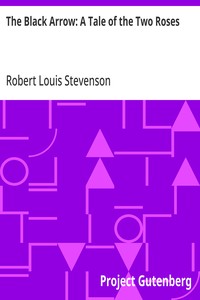
The Black Arrow: A Tale of the Two Roses — Reading Companion
44
7
Project Gutenberg
1997
Historical fiction; Knights and knighthood -- Fiction; War stories; Bildungsromans; Young men -- Fiction; Guardian and ward -- Fiction; Great Britain -- History -- Wars of the Roses, 1455-1485 -- Fiction; Outlaws -- Fiction
Readers of public-domain and historical texts
Project Gutenberg digital edition
en
Edition facts
Words: 83,929
Reading time: 365 min
Text sections: 8
Source:
Project Gutenberg record #848
Stevenson's dedication reveals this historical adventure was written for a young audience in rivalry with Alfred R. Phillips. The opening prologue sets the Wars of the Roses stage with a bell summoning villagers, while later excerpts show the outlaw Lawless using disguise and drink to secure a boat. The narrative voice shifts between formal description and colloquial dialogue.
Editorial Edition Score
4.7/5
★★★★★
★★★★★
Calculated from edition completeness, EPUB availability, text structure and catalogue metadata. Not a user rating.
Edition quality
Stevenson’s own preface to The Black Arrow is an unusual confession: he dedicates the book to a critic who never read it, and admits it was written “years ago for a particular audience” in rivalry with a now-obscure author, Alfred R. Phillips. The prologue that follows, “John Amend-All,” opens not with a battle but with a bell—the unexpected ringing of Tunstall Moat House’s bell draws villagers from their labours, a quiet summons that hints at hidden urgency. The landscape is described with precise, unhurried detail: the oak-framed houses, the bridge, the forest fringes. This is not a breathless start; it is a patient establishment of place and mood, characteristic of Stevenson’s method in this tale.
The Bell and the Forest: Setting as Signal
The opening pages of The Black Arrow do not rush into action. Instead, Stevenson devotes careful attention to the physical setting of Tunstall hamlet, describing the “long green valley,” the church among yews, and the “green elms and greening oak-trees” that bound the view. The bell that rings at an unaccustomed hour is the first narrative device—a sound that interrupts ordinary life and draws people toward the Moat House. The reader, like the villagers, is left wondering what the summons means. An express rider has passed through, but he carried sealed letters and knew nothing himself. This layered withholding of information is deliberate: Stevenson builds suspense not through immediate violence but through the slow accumulation of detail and the sense that something is being kept from both the characters and the reader.
Disguise and Deception: Lawless’s Shore Performance
Later in the excerpts, the outlaw Lawless demonstrates a different kind of narrative craft: the art of disguise. When he encounters Skipper Arblaster and his man Tom, Lawless adopts a “tipsified simplicity and good-fellowship,” claiming to have come into an estate and to have left the sea for spiced ale. His performance is detailed—he calls Arblaster “gossip,” praises the Good Hope as a “sweet shear,” and proposes a drink. The skipper, initially suspicious, is won over by the mention of an estate and by Lawless’s affected manner. The scene is comic but also strategic: Lawless is securing a boat for Dick’s escape. Stevenson gives the dialogue a salty, period flavour—Arblaster speaks of salt getting into his bones and needing to drink a draw-well—and the setting, a new timber shed with a fire of wreck-wood, reinforces the rough, improvised nature of the plan.
The Skiff and the Swell: A Fragile Departure
When Dick and his men finally take to the water, Stevenson’s description turns terse and physical. The skiff of the Good Hope is “easily distinguished by its extreme smallness and fragility.” Once they put out into the open harbour, the little boat “dipped into the swell and staggered under every gust of wind, like a thing upon the point of sinking.” The Good Hope itself lies far out, where the swell is heaviest. This is a moment of genuine precariousness, rendered in plain, forceful language. The contrast with the earlier, leisurely description of the hamlet is striking: the same author who spent paragraphs on oak trees and yews now gives us a few stark sentences of wind and water. The shift in pace and focus is a clue to Stevenson’s range—he can be both patient and abrupt, and the reader must adjust to these changes in narrative rhythm.
Voice and Register: From Formal Prologue to Colloquial Banter
One of the most noticeable features of the excerpts is the variation in language. The prologue is written in a formal, almost antiquated style: “On a certain afternoon, in the late springtime, the bell upon Tunstall Moat House was heard ringing at an unaccustomed hour.” The sentences are long, the vocabulary measured. But when Lawless speaks, the register shifts dramatically: “Why, ye be well met; nay, gossip, ye be right well met, upon the rood!” The dialogue is full of contractions, oaths, and colloquialisms. Skipper Arblaster’s speech is equally earthy: “let him drink a draw-well, he will never be quenched.” This juxtaposition of high and low styles is a deliberate narrative strategy. Stevenson uses formal narration to establish setting and situation, then switches to vigorous, idiomatic dialogue to bring characters to life. Readers should attend to these shifts, as they signal changes in narrative distance and focus.
Stevenson’s own preface warns that The Black Arrow was written for a particular audience and in rivalry with another author. The excerpts bear this out: the tale is episodic, with set pieces of description and dialogue that sometimes advance the plot slowly. A first-time reader may find the opening leisurely, but the later scenes of disguise and escape reward patience. Pay attention to the way Stevenson uses physical objects—a bell, a skiff, a fire of wreck-wood—to anchor his scenes. The story’s pleasures lie less in grand historical sweep than in the texture of its moments.
Reader reflection
Take a moment to reflect on this book
Create a short personal record of your experience with this book.
Your progress
0
/
10
2
Was reading this book enjoyable?
3
Would you recommend this book to another reader?
4
How easy was the book to follow?
5
How strong was your personal connection to the text?
6
Was the book easy to understand?
7
Could you apply anything you learned?
8
Did anything about the book feel genuinely new?
9
In one sentence, what did you learn?
10