1

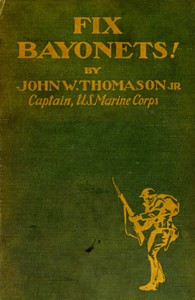
Fix bayonets! — Reading Notes
377
13
Project Gutenberg
2025
World War, 1914-1918 -- Fiction; War stories, American; United States. Marine Corps -- Fiction; United States -- History, Naval -- 20th century -- Fiction
Readers of public-domain and historical texts
Project Gutenberg digital edition
en
Edition facts
Words: 43,576
Reading time: 190 min
Text sections: 14
Source:
Project Gutenberg record #75092
John W. Thomason's 1926 collection of linked stories follows U.S. Marines in the 1918 Aisne-Marne offensive, blending firsthand observation with a novelist's eye for detail. The prose shifts from panoramic battle scenes to intimate moments of exhaustion and dark humor, capturing the specific texture of Marine Corps identity and combat.
Editorial Edition Score
4.8/5
★★★★★
★★★★★
Calculated from edition completeness, EPUB availability, text structure and catalogue metadata. Not a user rating.
Edition quality
John W. Thomason, a Marine captain who served in the 5th Regiment, wrote these stories from direct experience. The opening anecdote of a wounded Marine insisting “I’m a Marine” rather than an American sets the tone: this is a book about a particular tribe, not a general war. The prose moves between panoramic battle scenes—wheat fields, machine-gun nests, the Vierzy ravine—and quiet moments of exhaustion and dark humor. Thomason’s eye for detail is sharp: the “freckled boy” who goes mad with his bayonet after his brother is killed, the tank crew asking for cigarettes, the way men “crawl and shoot low among the poppies.” The result is a work that feels both documentary and literary, grounded in the physical specifics of the 1918 Aisne-Marne offensive.
The Texture of the Marine Corps
Thomason devotes his introduction to cataloguing the men of the Marine Brigade: Northwesterners with “straw-colored hair,” Eastern university men, Pacific-coast lumberjacks, drawling Southerners, and “diverse people who ran curiously to type, with drilled shoulders and a bone-deep sunburn.” Their speech is flavored with navy words and phrases from ports around the world. This is not a generic army; it is a specific institution with its own culture, one that Thomason treats with affectionate precision. The stories that follow show that culture under extreme pressure—the way a gunnery sergeant commandeers a German 105mm gun and turns it on the enemy, or how a lieutenant coolly assesses a map reference while surrounded by dead and wounded. The book’s title, Fix Bayonets!, is both a literal order and a symbol of the Marine ethos of closing with the enemy.
Combat as Fragmentary Experience
The battle sequences resist neat narrative. Thomason writes that “the rest was no connected story. Only the hot exaltation of the fight kept the men on their feet.” The prose itself becomes fragmentary: “There was crawling and shooting low among the poppies, and presently hand-to-hand fighting.” The reader is plunged into the same confusion as the participants. Details emerge in sharp bursts: a tank “stalled, its guns not working,” swarmed by Germans prying at its plates with bayonets; a hidden strong point in the wheat; a battery of 105s firing point-blank. Thomason does not explain the larger tactical picture; he gives the sensory overload of the front line. The effect is immersive and unsettling, a deliberate refusal to impose order on chaos.
Moments of Dark Humor and Humanity
Amid the violence, Thomason includes small, telling details that undercut the horror. After the tank is rescued, a “greasy, smiling Frenchman emerged head and shoulders and inquired after a cigarette.” A lieutenant, surveying his thin line, says, “Accordin’ to the map, we’re here. Turn those Boche machine-guns around—guess we’ll stay.” The humor is laconic, understated—a survival mechanism. These moments do not diminish the brutality; they make the men more human. The book also acknowledges the psychological toll: the freckled boy who “went himself quite mad among the wounded and the corpses with his bayonet.” Thomason does not dwell on trauma, but he does not ignore it. The result is a portrait of men who are both capable of extreme violence and capable of wry observation.
Readers should approach Fix Bayonets! as a series of linked episodes rather than a continuous narrative. Thomason’s background as an illustrator is evident in his visual, almost cinematic descriptions; the book rewards attention to small physical details—the look of wheat waist-high, the sound of a tank’s one-pounder gun, the feel of a sunken road. The stories are best read slowly, allowing the cumulative effect of exhaustion and exaltation to build. They offer a specific, unromanticized view of the Marine Corps in 1918, one that avoids both jingoism and antiwar sermonizing.
Reader reflection
Your personal reading reflection
Build a private reading journal entry for this title.
Your progress
0
/
10
2
How did the book work for you overall?
3
Would you recommend this book to another reader?
4
How easy was the book to follow?
5
Was the book what you thought it would be?
6
How closely did the book connect with your experience?
7
Could you apply anything you learned?
8
How clearly were the main ideas presented?
9
What is the main idea you are taking away?
10