1

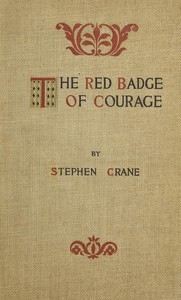
The Red Badge of Courage: An Episode of the American Civil War — Inside the Classic
39
9
Project Gutenberg
1993
Historical fiction; War stories; United States -- History -- Civil War, 1861-1865 -- Fiction; Virginia -- History -- Civil War, 1861-1865 -- Fiction; Chancellorsville, Battle of, Chancellorsville, Va., 1863 -- Fiction
Readers of public-domain and historical texts
Project Gutenberg digital edition
en
Edition facts
Words: 50,347
Reading time: 219 min
Text sections: 25
Source:
Project Gutenberg record #73
Stephen Crane's novel follows a young Union soldier through fear, flight, and a minor head wound during the Civil War, using impressionistic prose to render the chaos of battle and the soldier's inner turmoil.
Editorial Edition Score
4.8/5
★★★★★
★★★★★
Calculated from edition completeness, EPUB availability, text structure and catalogue metadata. Not a user rating.
Edition quality
The novel opens with an army awakening to rumors of movement, its restlessness conveyed through a landscape shifting from brown to green. A tall soldier spreads a tale of a flanking maneuver, while another private dismisses it as a lie, and a corporal laments his newly built floor. This early exchange establishes a pattern: the men oscillate between credulity and skepticism, their domestic concerns clashing with the impending campaign. Crane’s prose, with its precise sensory details—the “amber-tinted” river, the “red, eyelike gleam” of campfires—immerses the reader in a world where nature and war are intertwined.
Rumor and Restlessness in the Opening
The first chapter builds tension through conflicting voices. The tall soldier’s elaborate plan is met with immediate disbelief: “It’s a lie! that’s all it is—a thunderin’ lie!” The men argue, and the corporal’s complaint about his board floor reveals a desire for permanence that the army’s uncertainty denies. Crane does not identify the protagonist yet; instead, he presents a collective of soldiers, each reacting to the rumor differently. The narrative voice remains detached, recording gestures and speech without interiority. This technique forces the reader to infer the emotional climate from external behavior. The opening thus functions as a microcosm of the novel’s central concern: how individuals process fear and uncertainty in the absence of reliable information.
The Wound and Its Aftermath
Later in the text, the youth receives a head wound—a “red badge of courage” earned not in combat but from a fleeing soldier’s rifle blow. Crane describes the wound’s physical sensations with clinical precision: “a cool, liquid feeling” and the imagined movement of blood. The youth’s fear shifts from the enemy to his own body; he dreads stumbling and disturbing the injury. His thoughts turn to domestic memories—meals his mother cooked, swimming in a shaded pool—contrasting the present chaos with a pastoral past. The wound becomes a focal point for his anxiety, its silence more terrifying than pain. This section exemplifies Crane’s method of rendering psychological states through bodily experience, avoiding direct commentary on courage or cowardice.
The Chaos of Retreat and Artillery
In a later excerpt, the youth witnesses the army’s disarray: officers cursing like “fishwives,” cavalry and artillery jostling in a “mighty altercation.” Crane’s syntax mirrors the confusion—long, accumulating clauses pile detail upon detail. The guns “belched and howled like brass devils,” and the air fills with “tremendous remonstrance.” The youth, now separated from his regiment, observes the battle from a distance, seeing “sheets of orange light” and “heaving masses of men.” The landscape itself becomes a participant: “the blue haze of evening,” “long purple shadows.” Crane’s impressionistic style—favoring sensory fragments over coherent action—forces the reader to piece together the scene, much as the youth must navigate the fog of war.
The Weight of Fatigue and Memory
As the youth trudges through the dusk, his weariness becomes a physical burden: “His head hung forward and his shoulders were stooped as if he were bearing a great bundle.” He argues with himself about whether to sleep or press on, his body “persistent in rebellion.” Crane’s prose slows, mirroring the youth’s exhaustion. The narrative shifts between external description and internal debate, but never fully enters the youth’s mind; instead, it reports his thoughts as if overheard. This technique maintains a distance that prevents easy identification with the protagonist. The reader is left to observe his struggle without being told how to judge it. The closing lines of the excerpt, with their focus on the “little narrow roadway” now lifeless, underscore the isolation that follows the chaos of battle.
Readers should attend to Crane’s use of sensory detail and indirect narration. The novel does not explain its protagonist’s emotions; it presents them through physical reactions and fragmented perceptions. Pay particular attention to the recurring motifs of rumor, wound, and landscape—they form the structure through which the youth’s experience is filtered. The excerpts suggest a work more concerned with the psychology of fear than with military action.
Reader reflection
Before you leave, reflect on the book
Use these questions to collect your thoughts before moving on.
Your progress
0
/
10
2
Was reading this book enjoyable?
3
Is this a title you would suggest to others?
4
What was the reading difficulty like?
5
What did you appreciate most?
6
Did the book meet your expectations?
7
Would you read this book again?
8
Did the book give you something worth debating?
9
What changed or sharpened your thinking?
10